
Journalists cover trends, so trends belong in your pitch as context. They should not be the reason your story matters. By the time a "-maxxing" trend reaches peak coverage in major outlets, the pitching window has largely closed, and the strongest openings sit before mainstream pickup or after the backlash begins.
2026 has me maxed out. And maxed over it.
Protein-maxxing. Fiber-maxxing. Sleep-maxxing. Sense-maxxing. Most began as a social media moment, moved into traditional outlets and the news cycle, and became a hook for every brand with a product to move. Some have real merit. Protein and fiber are not nothing. But in communications, if the trend is what you are hanging your pitch on, you are missing the boat.
We looked at the timeline to see how big that gap is.
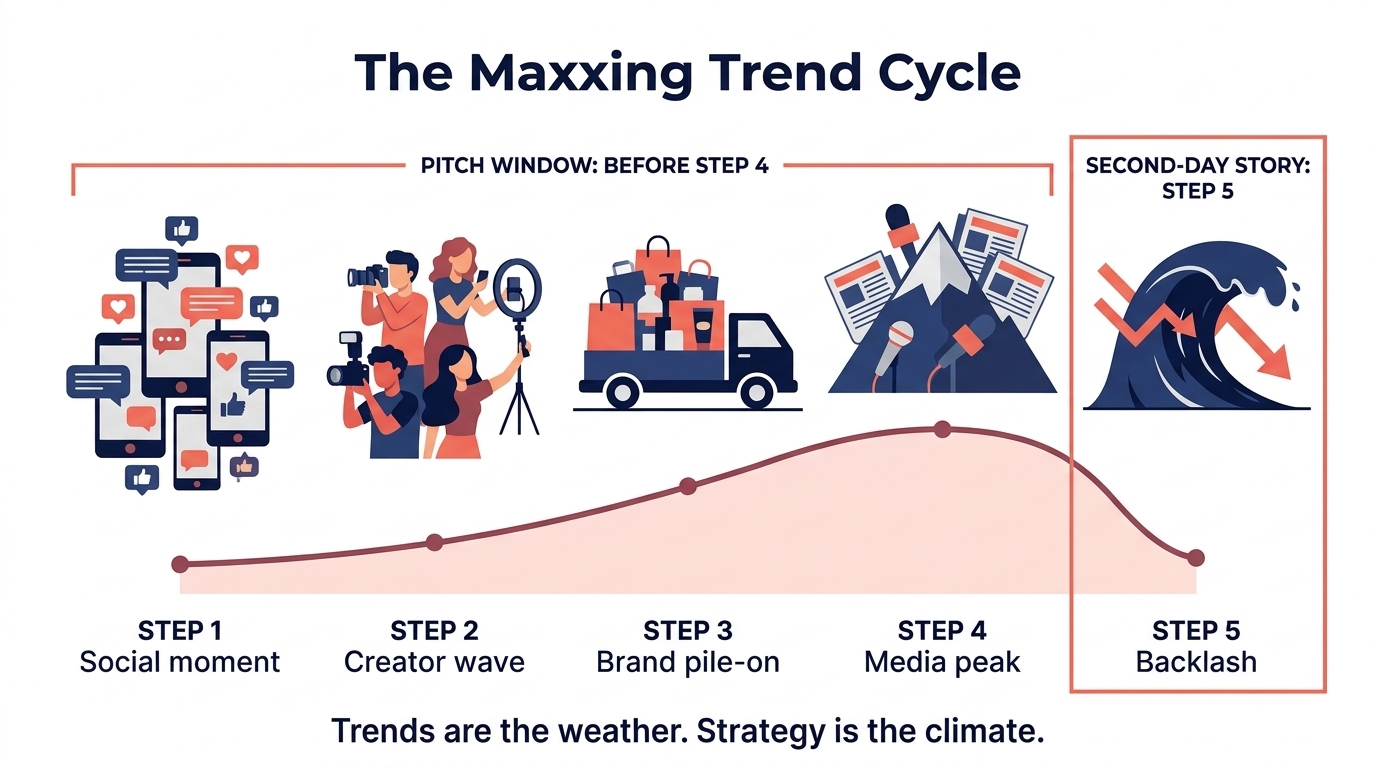
How long does a maxxing trend take to go from social to mainstream news?
It varies. Fiber-maxxing went from social growth to brand launches in about 18 months, according to New Hope Network. Protein had years of social life before brand and business-media saturation arrived in 2025.
| Trend | Social traction | Business and media saturation | Peak and backlash |
|---|---|---|---|
Protein-maxxing |
TikTok growth from about 2020, per an AMA podcast episode |
July to August 2025: CNBC covers the "protein frenzy" and restaurant adoption |
Bloomberg "peak protein", July 14, 2026; NYT reports cottage cheese fatigue, September 28, 2026; Reuters Breakingviews skeptical business coverage, October 8, 2026; Abbott repositions around the trend, October 9, 2026 |
Fiber-maxxing |
About 18 months of TikTok and influencer growth, per New Hope, December 4, 2025 |
CNBC, December 12, 2025, with PepsiCo announcing a February 2026 launch |
NPR cautions against extreme intake, May 18, 2026 |
Sleep-maxxing |
Established on TikTok by November 4, 2024 |
CNN, March 9, 2025; brand explainers such as Mindvalley, April 28, 2025 |
Expert caution appeared in the earliest coverage located, including Campaign US and Mindvalley |
Sense-maxxing |
Named Trend of the Year by the Specialty Food Association, January 12, 2026 (named by a trade association in the coverage found) |
FoodNavigator, January 19, 2026; brand content in mid-2026 |
Consumer concern about how bold colors and textures are produced, alongside an "honest processing" trend, per FoodNavigator |
Dates reflect the earliest coverage located, not verified first-ever mentions. Bloomberg and The New York Times may be paywalled.
A few data points show how far protein spread. Datassential reports that 28.4% of U.S. restaurant menus mention protein in 2025, up from 5.9% a decade ago. Reuters Breakingviews reports that Google searches for "high protein" more than doubled in the five years after the pandemic. And on the skeptic side, sleep researcher Sara Mednick calls sleepmaxxing "a marketing tool to make all the standard sleep health recommendations sound new and sexy."
What is the typical lifecycle of a maxxing trend?
Across these examples, the pattern repeats:
Social moment: A creator or community names a behavior.
Creator wave: Influencers amplify it across platforms.
Brand pile-on: Companies attach products, launches, and content, often before the media peak.
Media peak: National outlets explain and summarize the trend.
Backlash: Critics, experts, and fatigue stories arrive.
Protein shows it clearly. CNBC documented brands and restaurants piling in during summer 2025. Bloomberg and the NYT ran "peak" stories in July and September 2026, and the NYT itself reported cottage cheese fatigue. The brand pile-on often arrives before the media peak, which is why a pitch built on the trend reaches reporters after the window has closed.
Why is pitching a trend at the peak a weak strategy?
By the time a reporter is writing about a trend, your competitors are pitching the same angle. A pitch that leans on the buzzword competes on timing, and timing is the one thing you no longer control.
Should PR teams ignore trends altogether?
No. Journalists are covering them, so trends are fair context. They help explain why a story matters right now. They should never be the reason it matters.
What is the better test for any trend-based pitch?
Take the buzzword out.
Read the pitch again.
Ask whether the story still stands.
If it does, you have news, data, a point of view, or a human story that will outlast the cycle. Pitch it. If not, it was never the story.
Where are the real opportunities in a trend cycle?
Before the brand pile-on: Bring a data-backed story or credible expert while the trend is still on social.
At the backlash: Offer the thoughtful second-day story. Reporters look for sources who add nuance, as the NPR fiber coverage shows.
In trade press: Sense-maxxing was named by a trade association, a different pitching dynamic from a social-first trend. See the Specialty Food Association announcement.
Trends are the weather. Strategy is the climate.
How do you build a pitch that outlasts the trend cycle?
Lead with your client's own news, data, or point of view.
Use the trend as one sentence of context, not the headline.
Prepare a second-day angle in case coverage turns critical.
Avoid health or nutrition claims beyond what you can support.
A strategic communications plan is built to survive the moment. Learn more about our public relations services and the full range of Junapr services, or read our guide on how to choose the right PR agency for your business.
FAQ
What is "maxxing" in social media trends?
A suffix attached to a habit or category to signal optimizing it, as in protein-maxxing or sleep-maxxing. It started in online communities and spread to mainstream media and brands.
How long does it take a social trend to reach mainstream news?
In these examples, fiber-maxxing went from social growth to brand launches in about 18 months, according to one trade reporter. Protein had years of social life before brand and media saturation arrived in 2025.
Is it ever smart to pitch a trend?
Yes, as context, and when your story stands without the buzzword.
When is the best time to pitch around a trend?
Before the brand pile-on and mainstream peak, or after the backlash begins, with a story that has substance.